What Makes This Program Different?
Guaranteed Live Patient Experience
You’ll place implants on actual patients, from diagnosis to delivery—not just assist or watch.
Digital Workflow Integration
We’ll show you how to simplify treatment, reduce chair time, and improve outcomes using a fully digital approach—from planning to restoration.
Flexible Weekend Scheduling
Built with busy clinicians in mind. All lectures and clinicals are scheduled across select weekends from April 2026 to October 2026.
Course Overview
Module 1:
Theory: Begin with a history of implant dentistry, understanding implant materials and design,
as well as what to look for in consultation appointments with respect to patient medical history,
contraindications and site specific findings.
Hands-On: Learning how to plan various types of guided surgeries using an implant planning
software to fabricate guides for the provided simulated patients accounting for critical
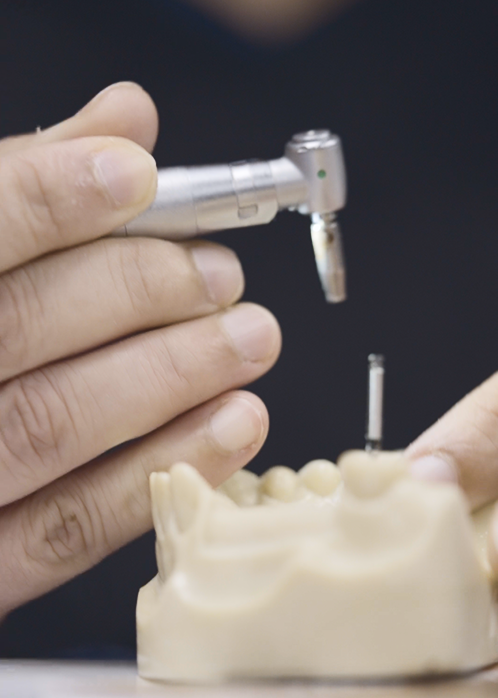
structures and anatomy; and practice drilling protocols for various implant systems on models.
Module 2:
Theory: Gain an understanding for surgical guidelines, techniques and materials to optimize
successful implant placement.
Hands-On: Practice surgical procedures such as surgical and atraumatic extractions, guidedbone-regeneration and implant placement on pig mandibles; and utilizing fabricated personal
surgical guides from Module 1 to place real implants on simulated patients.
Module 3:
Theory: Learning about assessing osseointegration and restoring basic implants, including
impression types, necessary components, prosthodontic principles to keep in mind when
planning restorations, and how to communicate accurately with labs to maximize results and
minimize chair-time.
Hands-On: Continue with simulated patients and perform impressions and intra-oral scans to
design and request final prosthetics from the lab
Module 4:
Theory: Understanding potential complications that may occur throughout implant therapy and
how to manage them efficiently.
Hands-On: Delivery of Module 3 prostheses on simulated patients and complete final scanning
for fabrication of nightguards.
Module 5:
Theory: Course completion and wrap-up with learning best-practices with respect to record
keeping, obtaining consent (including written), and billings.
Hands-On: Delivery of nightguards, marking the completion of the simulated patients in totality.
Live Patient Sessions:
Consultation Appointments Gathering medical, dental and social histories, complete
examinations to determine candidacy and finalize treatment plans for those eligible.
Surgical Appointments — Perform implant placement surgery following guidelines and under
supervision.
Impression/Scanning Appointments — Post-op osseointegration checks and impressions/
scanning for planning final prosthesis.
Delivery — Final prosthesis and nightguard delivery.
Follow-Up — Ensuring periodontal health post-case completion.
Course Objectives:
Assess candidacy for dental implants (accounting for medical, dental and social
histories, as well as contraindications)
Obtain informed consent from patients for necessary procedures with respect to basic
implant placement
Extract teeth surgically and atraumatically including various flap designs and suturing
methods
Perform basic guided-bone-regeneration (GBR) procedures
Choose appropriate implant, grafting and suturing materials for ideal placement based
on individual cases
Utilize digital workflows to plan ideal implant placements and fabricate surgical guides
on softwares after accurately overlaying CBCT and intra-oral scans to account for
anatomy and critical structures
Perform implant placement surgery utilizing free-hand, pilot-guided and fully-guided
workflows following protocols to minimize risk of surgical complications
Assess osseointegration and take appropriate impressions/scans for final prostheses
Identify and manage complications post-case completion (ex. Peri-implantitis)
Write essential records for each stage of treatment and understand codes for
appropriate billing practices